
FACADE LIGHTING INSTALLATION IN THE UAE
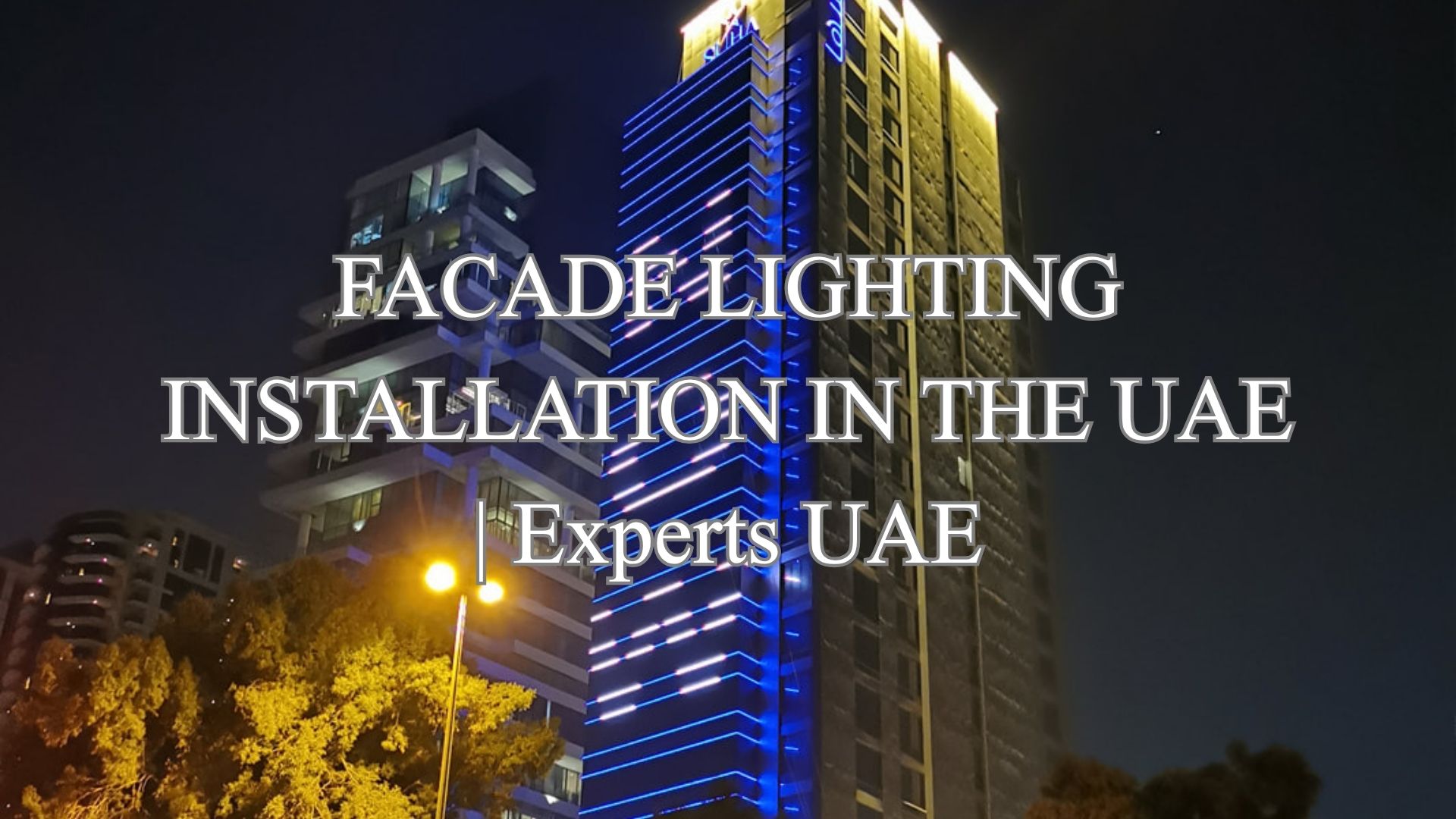
The United Arab Emirates skyline is one of the most dramatic and illuminated in the world. From the towering Burj Khalifa’s LED crown to the shimmering facades of Dubai Marina and Abu Dhabi’s gleaming cultural district, facade lighting has become a defining feature of UAE architecture. It serves far more than an aesthetic purpose — it signals brand identity, enhances safety, drives tourism, and contributes to the UAE’s reputation as a global hub of innovation and grandeur.
Whether you are a developer, architect, property owner, or lighting consultant planning a facade lighting project in the UAE, this guide covers everything you need to know — from regulatory compliance and climate considerations to fixture selection, energy efficiency, and commissioning.
1. Understanding the UAE Environment
The UAE’s climate and environment pose unique challenges that must be at the forefront of any facade lighting design decision. Failing to account for environmental factors is one of the most common causes of premature fixture failure, high maintenance costs, and project disappointment.
1.1 Extreme Heat and UV Radiation
Summer temperatures in the UAE regularly exceed 45 degrees Celsius, with radiant surface temperatures on sun-facing facades climbing even higher. UV radiation levels are among the highest globally. This means:
- Plastic components, diffusers, and gaskets degrade rapidly without UV-stable materials.
- LED drivers and electronics must be rated for ambient temperatures of at least 50 degrees Celsius (ideally 55 degrees or higher).
- Thermal management is critical — look for fixtures with proper heat sinking, ventilation provisions, or passive cooling design.
- Color stability matters: cheaper LEDs shift in color temperature under sustained heat, producing inconsistent illumination over time.
1.2 Humidity, Salt Air, and Sand
Coastal cities like Dubai, Abu Dhabi, Sharjah, and Ras Al Khaimah experience high humidity and salt-laden air, particularly in winter. Meanwhile, sandstorms (shamal) are a regular occurrence. Both conditions demand:
- IP66 or IP67 rated fixtures as a minimum — IP65 may be acceptable for sheltered areas only.
- Marine-grade stainless steel (316L), anodized aluminum, or powder-coated finishes resistant to salt corrosion.
- Sealed optical chambers to prevent sand and dust ingress that obscures light output and causes abrasion.
- IK08 or IK10 impact rating for ground-level and accessible fixtures prone to physical contact.
2. Regulatory Compliance and Approvals
The UAE has well-defined regulatory frameworks governing facade lighting. Non-compliance can lead to project shutdowns, fines, and mandatory removal of installed systems. Understanding the approval process before design begins is essential.
2.1 Key Governing Bodies
| Authority | Emirate | Responsibility |
|---|---|---|
|
Dubai Municipality (DM)
|
Dubai |
Building permits, facade aesthetics, public realm lighting
|
|
Roads & Transport Authority (RTA)
|
Dubai |
Street-facing facades, road-adjacent lighting, traffic impact
|
|
Dubai Electricity & Water Authority (DEWA)
|
Dubai |
Power connection, energy efficiency standards
|
|
Abu Dhabi Dept. of Municipalities (DMT)
|
Abu Dhabi
|
Building code compliance, facade approvals
|
|
Abu Dhabi Distribution Company (ADDC)
|
Abu Dhabi
|
Electrical connection and load approvals
|
|
Sharjah City Municipality
|
Sharjah
|
Facade lighting regulations and permits
|
2.2 Light Pollution and Glare Restrictions
The UAE is increasingly attentive to light pollution, particularly near residential areas, airports, and natural reserves. Look for and comply with the following:
- Upward Light Ratio (ULR): Minimize upward-directed light; full cut-off luminaires are preferred in most zones.
- Obtrusive Light Limits: Adhere to CIE 150:2017 guidelines for luminance and illuminance limits at neighboring properties.
- Airport Proximity: Obtain NOC (No Objection Certificate) from the General Civil Aviation Authority (GCAA) for any lighting near flight paths — especially for high-rise towers.
- Curfew Hours: Many municipalities restrict dynamic, colored, or animated facade lighting after midnight or 1 AM.
3. Facade Lighting Design Principles
Great facade lighting balances architectural intent, brand expression, and operational practicality. Before selecting a single fixture, the design brief must be thoroughly established.
3.1 Define the Lighting Objectives
- Accent Lighting: Highlighting architectural features, columns, arches, or ornamental details.
- Wash Lighting: Uniformly bathing large facade planes in color or white light.
- Grazing: Raking light across textured surfaces (stone, concrete, mesh) to reveal depth and materiality.
- Media Facades: Full dynamic pixel-mapped displays using individually addressable LED fixtures.
- Perimeter / Outline Lighting: Defining building silhouettes with linear LED profiles.
3.2 Colour Temperature and Colour Rendering
Colour temperature (CCT) dramatically affects how a building reads against the night sky. In the UAE context:
- 2700K-3000K (Warm White): Ideal for hospitality, luxury retail, heritage, and residential facades. Creates a welcoming, premium ambience.
- 4000K-5000K (Neutral to Cool White): Suited to commercial towers, corporate HQs, and modern glass-curtain facades.
- Tunable White (2700K-6500K): Provides flexibility to shift scenes throughout the year, including National Day or Ramadan themes.
- RGBW / RGBA: Full-color dynamic facades for landmark, entertainment, or mixed-use developments.
Always specify a minimum Colour Rendering Index (CRI) of Ra 80 for facades where occupants or visitors interact directly with lit surfaces. For retail and hospitality, Ra 90+ is recommended.
4. Fixture Selection: What to Look For
Choosing the right luminaires is one of the most consequential decisions in any facade lighting project. The market is flooded with products of varying quality, and in the UAE environment, poor-quality fixtures fail within months.
4.1 IP and IK Ratings
| Location | Minimum IP Rating | Notes |
|---|---|---|
|
Rooftop / exposed
|
IP67 |
Also consider IK10 for maintenance traffic areas
|
|
Mid-rise facade (sheltered)
|
IP65 |
IP66 preferred for coastal locations
|
|
Ground level / podium
|
IP66 + IK10
|
Exposed to cleaning jets and pedestrians
|
|
Inground / paved
|
IP68 (3m rated)
|
Full submersion-rated; load-bearing required
|
|
Underwater / fountain
|
IP68 + IK10
|
Corrosion-resistant housing mandatory
|
4.2 LED Driver Quality
The driver is the brain of any LED system and often the first component to fail. Specify the following:
- ENEC or UL certified drivers from reputable manufacturers (Tridonic, DALI Works, Meanwell, Osram, Inventronics).
- Minimum 50,000-hour rated life at 50 degrees Celsius ambient.
- Power Factor >=0.95 and THD <15% to meet DEWA/ADDC grid quality requirements.
- DALI-2 or DMX512/RDM protocol support for control system integration.
- Surge protection: minimum 4kV/2kA for open environments; 10kV for rooftop or lightning-exposed installations.
4.3 LED Chip Quality and Lumen Maintenance
- Use Tier 1 LED chips (Cree, Osram, Lumileds, Nichia, Samsung) — avoid generic chips without LM-80 test data.
- Minimum L70B10 rating of 50,000 hours — meaning at least 90% of fixtures maintain 70%+ output at that mark.
- SDCM (MacAdam Ellipses) 3 steps or less for white light fixtures — critical for color uniformity across a facade.
- For RGBW systems, request delta u’v’ color coordinates at full life span from the manufacturer.
5. Electrical Infrastructure and Power Planning
The electrical backbone of a facade lighting system is frequently underestimated during design, only to become a source of major cost overruns during construction.
5.1 Load Calculation and Power Supply
- Calculate total connected load and apply a 20-25% diversity and safety factor.
- Design dedicated lighting distribution boards (LDB) isolated from other building services to prevent interference.
- Use three-phase power distribution to balance loads across large facades.
- Specify cable routes with short runs where possible — voltage drop on low-voltage LED systems must be kept below 3% per IEC 60364.
5.2 Cabling Specifications for UAE Conditions
- Use LSZH (Low Smoke Zero Halogen) cables rated for 90 degrees Celsius minimum — standard PVC cables fail in direct UAE sun exposure.
- All external cables must be routed in UV-stabilized conduit or armored (SWA) and secured with stainless steel cleats.
- Data cables (DMX, DALI, Ethernet) must be shielded to resist EMI interference from building systems.
- All outdoor junction boxes must be IP65 minimum with stainless steel hardware.
6. Lighting Control Systems
For any facade lighting project in the UAE of meaningful scale, a sophisticated control system is not optional — it is expected. Major landmarks and commercial properties use control systems to enable dynamic programming, energy monitoring, and seasonal scheduling.
6.1 Control Protocols
- DMX512/RDM: Industry standard for dynamic, pixel-level RGB control. Ideal for entertainment and media facades.
- DALI-2: Best for architectural white light control, energy monitoring, and fault reporting. Supports addressable drivers.
- Art-Net / sACN: Ethernet-based protocols for large-scale pixel-mapped installations over IP networks.
- KNX / BACnet Integration: For Building Management System (BMS) integration — common in Grade A commercial towers.
6.2 Scene Programming and Scheduling
UAE-specific programming considerations include mandatory scheduling for:
- UAE National Day (December 2-3): Green, white, black, and red national color themes.
- Ramadan and Eid: Crescent and star motifs, warm golden tones, festive animated sequences.
- New Year’s Eve: High-intensity dynamic sequences coordinated with fireworks.
- Daily Dusk-to-Dawn: Standard operational scenes with automatic sunset/sunrise triggering via astronomical clock.
- Energy Reduction Modes: Dimming to 30-50% after midnight per municipality requirements.
7. Energy Efficiency and Green Building Standards
The UAE Vision 2031 and individual emirate sustainability strategies place strong emphasis on energy efficiency in buildings. Facade lighting must align with these standards to gain approvals and achieve green certifications.
7.1 Key Standards and Certifications
- Estidama Pearl Rating (Abu Dhabi): Requires lighting power density (LPD) compliance and energy metering for facade lighting.
- LEED v4 (Dubai & Free Zones): Exterior lighting must comply with ASHRAE 90.1 LPD limits and obtrusive light controls.
- DEWA Green Building Regulations: Encourage solar-powered accent lighting for low-rise podiums and landscaping.
- WELL Building Standard: Relevant for mixed-use developments; controls facade lighting impact on circadian rhythms of occupants.
7.2 Energy Efficiency Best Practices
- Target LED efficacy above 100 lumens per watt for all facade fixtures.
- Implement occupancy-responsive dimming for canopy, podium, and access areas.
- Install energy sub-metering on the facade lighting circuit for real-time consumption tracking.
- Evaluate solar-powered options for standalone landscape or low-wattage perimeter features.
8. Structural and Facade Integration
How and where fixtures are mounted has profound implications for safety, maintenance, and aesthetics. This must be coordinated with the facade engineer and main contractor from the earliest design stage.
- Structural Load: All fixture mounting points must be structurally engineered, particularly for heavy or wind-exposed rooftop units.
- Thermal Expansion: Facade cladding expands significantly in UAE heat; use slotted or floating fixing systems to prevent cracking or fixture distortion.
- Concealment: Where possible, recess fixtures into cladding joints or sills to create clean aesthetics and protect from direct UV.
- Waterproofing Continuity: Any penetration through facade membranes or curtain wall units must be sealed with approved waterproofing collars.
- Maintenance Access: Design for safe and practical access — most mid-rise and high-rise facades in the UAE require BMU (Building Maintenance Unit) or rope access planning.
9. Installation, Testing, and Commissioning
The UAE Vision 2031 and individual emirate sustainability strategies place strong emphasis on energy efficiency in buildings. Facade lighting must align with these standards to gain approvals and achieve green certifications.
9.1 Contractor Qualifications
In the UAE, all electrical installation work must be carried out by DEWA-approved (Dubai) or ADDC-approved (Abu Dhabi) licensed electrical contractors. Verify the following:
- Valid UAE electrical contracting license and relevant authority approval.
- Demonstrated experience with facade lighting on comparable building typology and height.
- Competency in the specified control protocol (DMX, DALI, Art-Net).
- HSE safe work-at-height credentials for installation at elevation.
9.2 Testing Protocol
- Pre-installation inspection: Verify all fixtures, drivers, and cables match approved submittals.
- Insulation resistance testing: All circuits tested to 500V DC minimum with 1 megaohm or greater result.
- Earth continuity testing: Confirm all metalwork is properly earthed.
- Functional testing: Power each zone independently, verify correct addressing and colour output.
- Photometric verification: Use a calibrated lux meter or luminance camera to verify design intent is achieved.
- Scene sign-off: Run all pre-programmed scenes with client, municipality representative if required, and lighting designer.
- Thermal burn-in: Run system at full load for 72 hours continuously to identify early failures before handover.
10. Maintenance Planning
In the UAE, facade lighting maintenance is often overlooked at project inception but becomes a critical operational concern. Sand accumulation, heat degradation, and corrosion all accelerate maintenance cycles compared to temperate climates.
- Cleaning: External fixtures require cleaning every 3-6 months minimum. Sand and calcium deposits from irrigation significantly reduce light output.
- Driver Replacement: Budget for driver replacement at Year 5 and Year 10 even with quality drivers.
- Spare Parts: Maintain a minimum 10% spare stock of all fixture types on site or with a local distributor.
- Control System Software: Budget for annual control system software support and firmware updates.
- Preventive Maintenance Contract: Engage a specialist facade lighting contractor on a biannual PPM (Planned Preventive Maintenance) contract.
- Remote Monitoring: Where DALI-2 or networked control is installed, configure automated fault alerts for rapid response.
11. Common Mistakes to Avoid
- Specifying fixtures based on price rather than verified performance data in high-temperature conditions.
- Omitting thermal analysis — a fixture that performs perfectly in Europe may fail within a year on a UAE south-facing facade.
- Designing a complex media facade without a content delivery strategy — the hardware is only as valuable as its content.
- Neglecting GCAA NOC for high-rise towers — a late-stage rejection forces expensive redesigns.
- Using standard PVC cables exposed to direct sunlight — they crack within 2 years.
- Failing to coordinate fixture locations with the facade contractor before panel fabrication — retrofit mounting on curtain wall is extremely costly.
- Procuring fixtures without local after-sales support — in the UAE, support from a locally registered supplier or distributor is essential.
Conclusion
Facade lighting in the UAE is a sophisticated discipline that demands deep coordination across architectural, engineering, electrical, regulatory, and operational domains. The UAE’s extreme climate, ambitious aesthetic standards, and evolving sustainability agenda make it both one of the most exciting and one of the most demanding environments in the world for facade lighting professionals.
By engaging qualified design consultants, specifying proven products with full environmental certifications, planning meticulously for regulatory approvals, and investing in quality control systems and maintenance programs, your facade lighting installation can deliver decades of reliable, spectacular, and energy-efficient performance.
In a skyline as competitive as Dubai or Abu Dhabi, great facade lighting is not merely a feature — it is a statement.
