
Home EV Charger Installation in UAE: Everything You Need to Know in 2026
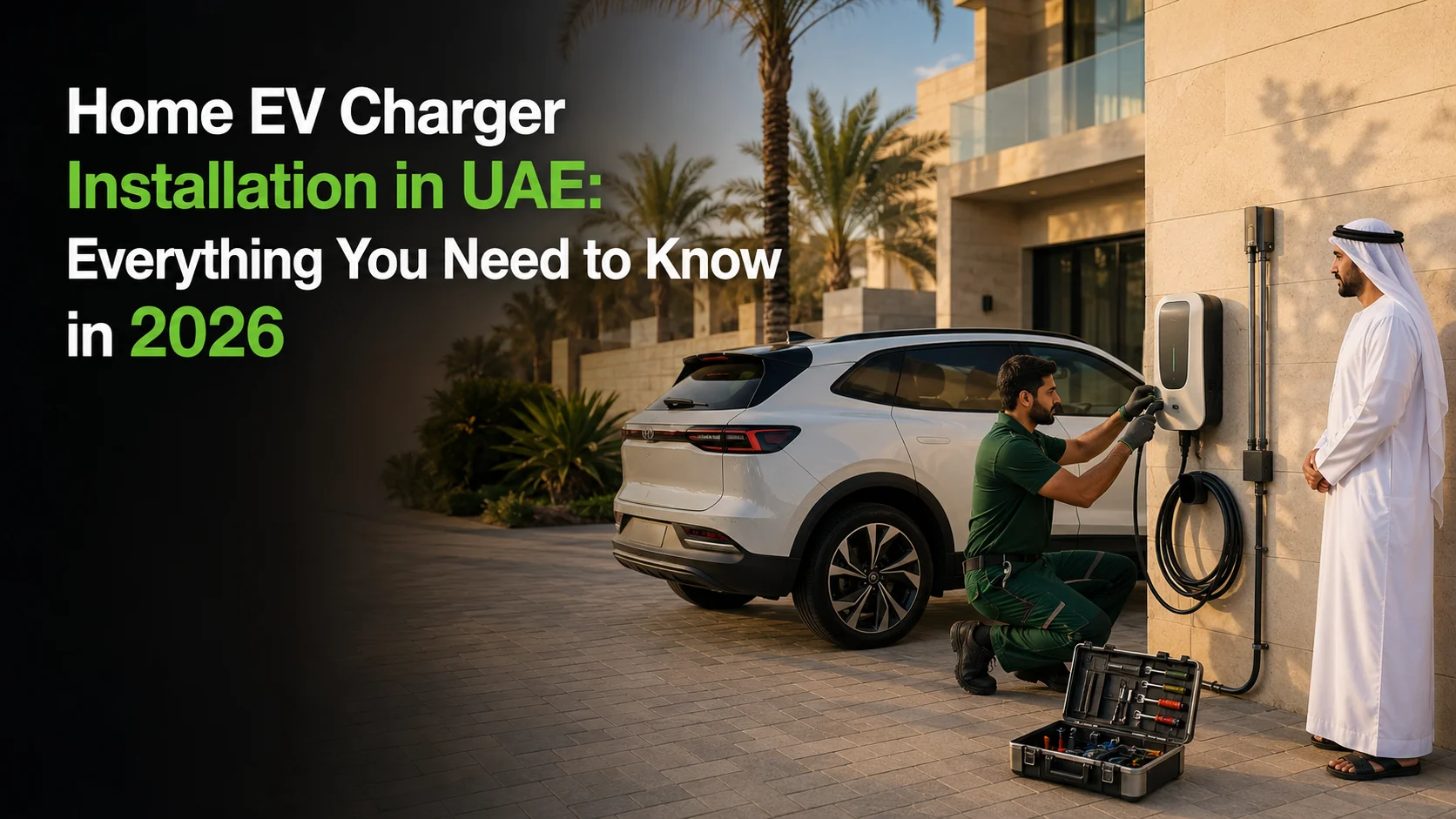
Home EV Charger Installation in UAE is becoming increasingly relevant as electric vehicles are no longer a niche choice on UAE roads. With Dubai targeting 10,000 public EV Green Charger stations by the end of 2026 and Abu Dhabi’s TAQA network maturing quickly, more homeowners are asking the same question: how do I get a charger installed at my villa or apartment legally and safely?
This guide covers everything involved in Home EV Charger Installation in UAE in 2026 – approvals, charger types, realistic costs, and how to choose an installer you can trust.
Key Takeaways
- Around 80% of EV charging happens at home rather than at public stations, making a home charger the single biggest upgrade to daily EV ownership.
- Every home installation must be approved by the relevant utility – DEWA in Dubai, ADQCC and TAQA in Abu Dhabi – and carried out by a licensed contractor.
- Villa installations are generally straightforward; apartment owners need a No Objection Certificate (NOC) from building management before work begins.
- Home charging costs roughly AED 0.29–0.44 per kWh, versus AED 1.20+ at public fast chargers, often delivering payback within two to four years.
Why UAE Homeowners Are Installing EV Chargers in 2026

The UAE’s EV charging infrastructure has expanded rapidly. Dubai alone had 2,223 EV charging points by the end of Q1 2026 across DEWA’s network and licensed third-party operators, backed by a roughly AED 2 billion plan to reach 10,000 stations by December 2026. Abu Dhabi’s Charge AD network now runs around 1,000 chargers across roughly 400 locations on Abu Dhabi Island, Al Ain and Al Dhafra.
Even so, public infrastructure can’t match the convenience of plugging in at home overnight. Queues at popular stations can run 30 minutes or more during peak hours, and public fast-charging tariffs cost considerably more than home rates. A residential EV charging solution removes range anxiety and turns charging into a background task rather than an errand.
Types of Home EV Chargers Available
Most UAE homes use one of the following:
- 7 kW AC wall charger – The standard entry point for villas, delivering a full charge overnight from a standard household connection upgrade.
- 11kW AC charger – A common mid-tier option for owners who want faster overnight top-ups, particularly for larger-battery EVs.
- 22kW AC charger – The fastest AC option typically installed at home, though it usually requires a three-phase electrical supply.
Portable “granny” cables exist but aren’t recommended for regular use – they charge slowly and strain household wiring not designed for sustained loads. A dedicated, professionally wired AC EV charger with its own circuit and breaker is the safer long-term choice.
Getting Approval: DEWA, TAQA Distribution, ADQCC

For Home EV Charger Installation in UAE, a charger draws significant, sustained current, so it can’t simply be plugged in and forgotten – it must be registered with your local utility, which, in Abu Dhabi, leads to a dedicated meter for the charger.
- Dubai – Falls under DEWA’s EV Green Charger programme. Equipment must carry proper certification (such as IEC 61851), and DEWA has introduced subsidies toward home installation for eligible villa and apartment-building owners.
- Abu Dhabi – TAQA Distribution handles the relevant electricity distribution and EV charging requirements in Abu Dhabi. Equipment must meet applicable ADQCC standards, and a dedicated meter may be required so EV charging consumption can be measured and billed accurately.
Villa owners typically own both the panel and parking area, so approvals move quickly once a load assessment confirms the property can support the extra circuit. Apartment owners need one more step: a No Objection Certificate (NOC) from building management or the Owners Association before work in shared parking can begin – roughly two-thirds of UAE EV owners live in apartment towers rather than villas.
The Installation Process, Step by Step

- Site assessment – A certified electrician evaluates your electrical capacity, panel location, and distance to your parking spot.
- Load study and equipment selection – The installer confirms whether your supply can handle the added load and recommends a charger (7 kW, 11 kW or 22 kW) suited to your vehicle.
- NOC and authority approval – For apartments, the NOC comes first; technical drawings are then submitted to DEWA, TAQA, and ADQCC as applicable.
- Dedicated circuit installation – A separate breaker and cable run go from the panel to the charging point, using weatherproof, UAE-climate-rated materials.
- Charger mounting and commissioning – The unit is mounted, wired, and tested, including earthing and residual current protection.
- Meter registration and final inspection – In Abu Dhabi especially, the authority installs a dedicated meter so that consumption is billed accurately.
- Handover – You receive a working charger, warranty documentation, and app access for monitoring (for smart chargers).
A straightforward villa installation can often be completed within a day once approvals are in place; apartment installations usually take longer due to the NOC and shared-infrastructure coordination.
What Does Home EV Charger Installation Cost in UAE in 2026?
| Cost Factor | Typical 2026 Estimate | What Affects the Cost |
|---|---|---|
|
EV Charger Hardware
|
From AED 1,950
|
Charger power, brand and smart features
|
|
Installation & Materials
|
AED 800–2,500+
|
Cable length, panel upgrades and trenching |
|
Home Charging Cost
|
AED 0.29–0.44/kWh |
Residential electricity tariff |
|
Public Fast Charging |
AED 1.20+/kWh |
Charger/operator and charging type |
|
Potential Payback |
2–4 years |
Driving frequency and home vs. public charging usage |
Costs vary with charger power, cable run length, and whether the panel needs upgrading, but typical 2026 pricing looks like this:
- Hardware: A 7 kW–11kW AC home EV charger typically starts around AED 1,950, depending on brand and smart features.
- Installation labour and materials: Often an additional AED 800–2,500+, depending on cable run length, panel upgrades, and trenching needs.
- Running costs: At roughly AED 0.29–0.44 per kWh at home versus AED 1.20+ at public fast chargers, most owners recover the cost within two to four years through charging savings alone.
- Subsidies: Dubai has introduced support toward home charger installation for eligible villa owners and multi-EV apartment buildings – it’s worth checking eligibility before booking.
Get a written, itemised quote – charger, cable, breaker, civil works, labour, and authority fees – rather than a single lump-sum figure.
Choosing the Right Installer

For Home EV Charger Installation in UAE, not every electrician is authorised to connect an EV charger to the grid. Before booking, confirm your installer:
- Is certified to work with DEWA, ADQCC and TAQA, depending on your emirate
- Uses ADQCC-compliant equipment and IP65/IP66-rated enclosures suited to UAE heat and humidity
- Handles the full paperwork trail – NOC, technical drawings, meter registration – rather than leaving you to chase approvals
- Offers a genuine warranty and aft
Ready to Switch to Home EV Charging?

Eurosec has spent 18 years delivering certified electrical and energy solutions across the UAE, with ADNOC and ADQCC-approved EV charging installations spanning 7 kW home units to high-power commercial chargers. The team handles site assessment, authority approvals, IP65-rated equipment built for UAE conditions, and app-based monitoring – so your home charger is installed correctly the first time.
If you’re planning Home EV Charger Installation in UAE, get in touch with Eurosec for a site assessment and a written quote tailored to your property.
Frequently Asked Questions
Yes, home EV charging can be possible in apartment parking areas, but the process may involve additional requirements. You may need a No Objection Certificate or permission from your building management or Owners Association, particularly where cabling passes through shared areas.
For a straightforward villa with suitable electrical capacity and a simple cable route, the physical installation may be completed within a day. The overall timeline can be longer when approvals, building permissions, electrical upgrades or shared parking infrastructure are involved.
For many EV owners, yes. A 7 kW charger can provide substantial overnight charging and is often sufficient for typical daily commuting. The best charger size ultimately depends on your EV’s battery capacity, onboard charger, daily mileage and available electrical supply.
Not necessarily. A 22kW charger only provides its full benefit when your property has the required three-phase electrical capacity and your EV can accept that level of AC charging. For many households, a 7 kW or 11kW charger provides a more practical balance.
Start with your property’s electrical capacity, your EV’s charging capability, the charger’s safety and environmental protection, applicable local requirements, installation cost, warranty and after-sales support. Apartment residents should also confirm building permissions before proceeding.
Sources
- DEWA — EV Green Charger stations at Al Shera’a, July 2026
- Dubai Electricity and Water Authority — 10,000 EV charging stations by 2026 expansion plan, 2026
- Watts & Ergon — EV Charger Installation in UAE: Cost & Requirements 2026, May 2026
- BYD Accessories Store — BYD Charging UAE 2026: DEWA, Charge2MOOV & Home Setup, June 2026
- Abu Dhabi Distribution Company (ADDC) — EV Charging Tariff Registration
- EV Shield — EV Charger Installation in Abu Dhabi, January 2026
- Eurosec — Trusted EV Charging in Abu Dhabi, January 2026
