
Trusted EV Charger Brand in UAE for Homes, Villas and Apartments
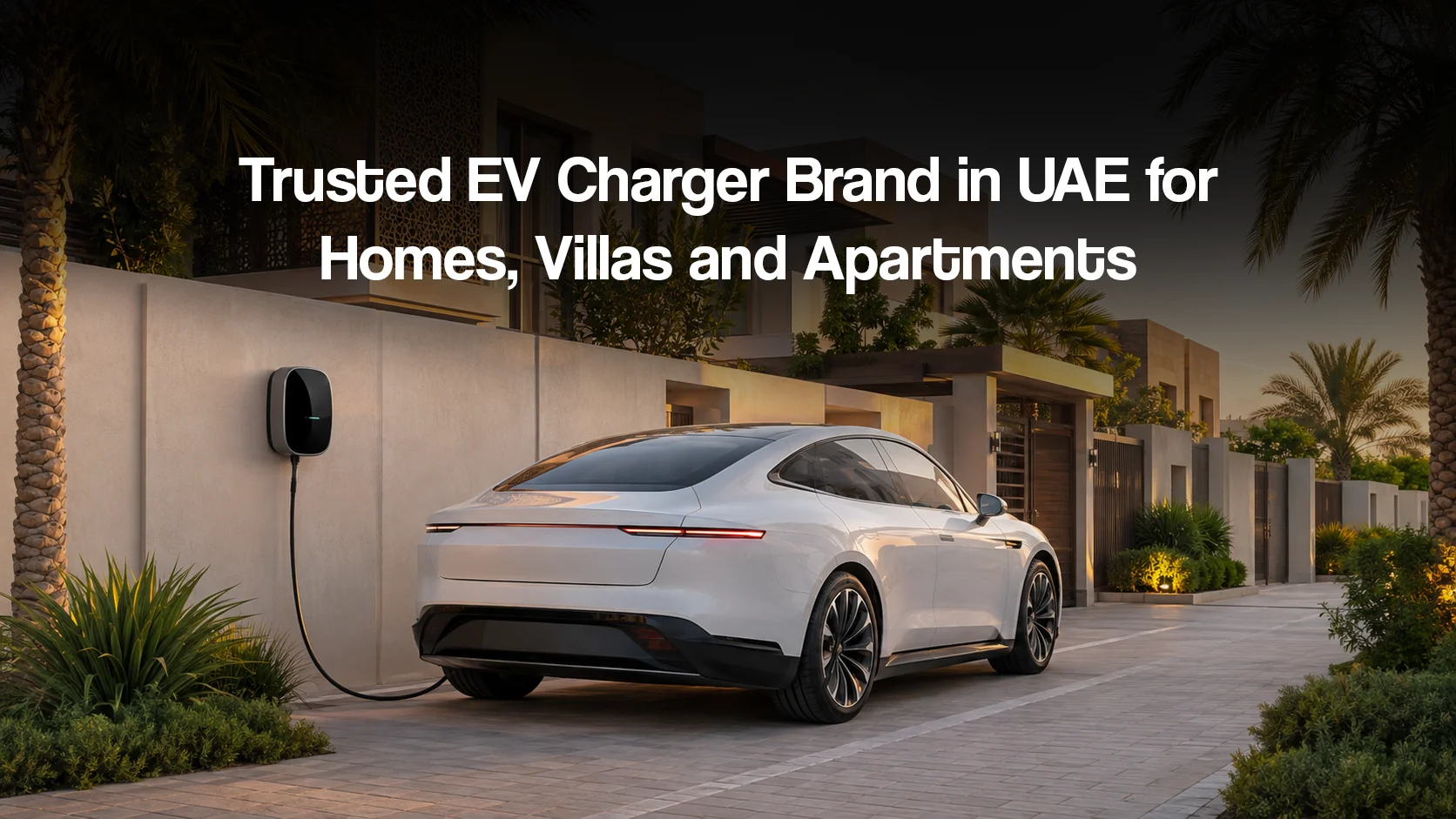
Choosing a Trusted EV Charger Brand in UAE matters, as electric vehicles are no longer a novelty on UAE roads, and the charger sitting in your garage or parking bay matters just as much as the car itself. The market is now crowded with imported units, grey-market resellers and brands that skip local certification altogether, which makes choosing a Trusted EV Charger Brand in UAE one of the most consequential decisions a homeowner or building manager will make this year.
Key Takeaways
- The UAE topped the Middle East in EV sales for a second straight year, capturing close to half of all regional EV sales in 2026 (IEA Global EV Outlook 2026, retrieved 2026-08-12).
- A trusted charger brand should carry DEWA or ADQCC approval, SASO compliance, and IP65/IK10 protection ratings suited to UAE heat and dust.
- Villas, apartments and shared-parking buildings each have different electrical and approval requirements — one charger size does not fit all.
- Warranty length, after-sales support, and smart-charging software are better long-term trust signals than price alone.
The UAE's EV Boom Is Outpacing Casual Charger Choices

The UAE’s shift to electric mobility is not a slow trend – it is compounding. Pure EVs made up roughly 3.4% of new car sales in 2025, a figure the industry is watching closely against the country’s 2050 target of 50% battery-powered vehicles. At the same time, the UAE’s hybrid and EV market is projected to grow from about USD 3.16 billion in 2025 to USD 3.84 billion in 2026, on its way toward roughly USD 10.2 billion by 2031.
Infrastructure is scaling to match. Dubai’s utility provider announced plans to expand public charging stations by 170% within three years, taking the network from 370 stations to around 1,000. That public momentum is exactly why home EV charging in UAE quality matters more, not less — most EV owners still do the bulk of their charging overnight at home, and a poorly built charger becomes the weak link in an otherwise fast-moving ecosystem.
Key Factors That Define a Reliable EV Charger in the UAE

Choosing a Trusted EV Charger Brand in UAE involves more than comparing power ratings, features, or price. For UAE homes and businesses, a charger should meet local requirements, perform reliably in demanding weather conditions, and come with dependable long-term support.
Here are four important factors to consider:
1) Utility and Regulatory Compliance
In Dubai, check applicable DEWA requirements, while in Abu Dhabi, look for relevant ADQCC compliance and TAQA Distribution requirements. These checks help ensure the charger and installation are suitable for the UAE’s local EV charging regulations in UAE and electrical infrastructure.
2) Recognised Product Safety Standards
Check whether the charger meets relevant international and regional electrical safety standards. Certifications covering electrical insulation, overload protection, temperature protection, and other built-in safety mechanisms provide greater confidence when installing equipment connected to your property’s electrical supply.
3) Strong Environmental Protection Ratings
UAE heat, dust, humidity, and outdoor exposure can put charging equipment under significant stress. Look for chargers with strong environmental protection, such as IP65 for dust and water resistance and IK10 for impact resistance, particularly for outdoor or semi-outdoor installations.
A charger designed for demanding conditions can provide better reliability and help reduce unnecessary maintenance over its operating life.
4) Warranty and Reliable After-Sales Support
A certified EV charger is a long-term investment, so support shouldn’t end once installation is complete. Look for brands that provide clearly documented warranty coverage, technical assistance, spare-parts availability, and local after-sales support.
Reliable service becomes particularly important if the charger requires troubleshooting, maintenance, software assistance, or replacement components later in its lifecycle.
Home, Villa or Apartment: Why Property Type Changes the Answer

Your property type plays an important role in determining the right residential EV charging solution. Electrical capacity, parking access, cable routing, building permissions, and metering requirements can differ significantly between villas and apartments.
Understanding these factors early can make the installation process smoother and help you choose a charger that works well for your property.
1) Villas
Villa owners typically have the most flexibility — a dedicated electrical circuit can usually be run to a private garage or driveway. The main considerations are charger power output (7 kW to 22kW AC units are common for overnight charging) and whether the property’s electrical panel has spare capacity without an upgrade.
2) Apartments
Apartment charging is constrained by shared infrastructure. Installation typically requires building management or facilities approval, and the charger often needs to integrate with a shared electrical metering or billing system so costs are allocated fairly across residents.
3) Shared and Community Parking
For villa communities and gated developments, multiple households may draw from a shared distribution board. This is where dynamic load balancing becomes essential — a trusted brand’s charger should be able to throttle output dynamically so it never trips the building’s supply during peak demand.
Key Features to Look for in a Trusted EV Charger Brand

When comparing options for a Trusted EV Charger Brand in UAE, look beyond the initial price. The quality of the hardware, safety compliance, software capabilities, warranty, and availability of local support can have a much greater impact on long-term reliability and ownership experience.
- Certification & Regulatory Compliance — Choose charging equipment that meets applicable DEWA, ADQCC and TAQA Distribution requirements, along with recognised electrical safety standards. Proper compliance is particularly important for safe installation and approval in the UAE.
- Strong Environmental Protection — UAE conditions can expose charging equipment to heat, dust, humidity, and outdoor elements. Look for robust protection ratings such as IP65 for dust and water resistance and IK10 for impact protection, particularly for outdoor installations.
- Practical Smart Charging Capabilities — A good smart charger should offer more than basic connectivity. Features such as remote monitoring, charging schedules, energy usage tracking, dynamic load balancing, and app-based control can make charging easier to manage while helping optimise available electrical capacity.
- Compatibility With Different EVs — Check that the charger supports the appropriate connector standards and is compatible with a wide range of EV models available in the UAE. This becomes especially important if you change vehicles or need to charge more than one EV in the future.
- Clear Warranty & Long-Term Reliability — Review the warranty period, what components are covered, and whether extension options are available. A strong warranty backed by an established manufacturer provides greater protection against unexpected repair or replacement costs.
- Accessible Local Installation & After-Sales Support — Reliable support shouldn’t end once the charger is installed. Prioritise brands that can provide local technical assistance, troubleshooting, maintenance, spare parts, and installation support when required. Having responsive local EV charger support in UAE can make a significant difference throughout the charger’s operating life.
Common Mistakes UAE Homeowners Make

- Choosing based on price alone. Unapproved imports are often 20-30% cheaper but carry no DEWA/ADQCC/TAQA certification, which can complicate insurance claims and building approvals later.
- Ignoring panel capacity. Installing a 22kW charger on a circuit that can’t support it risks tripped breakers or, worse, fire hazards.
- Skipping site assessment. A reputable EV charger installer in UAE always inspects the property’s electrical load before quoting — if a supplier skips this step, treat it as a red flag.
- Overlooking software. A charger without scheduling or load management can spike electricity costs during peak DEWA/ADQCC/TAQA tariff windows.
Why Eurosec Is a Trusted Name in UAE Home EV Charging

Eurosec has worked in EV charging, automation and building systems across the UAE for close to two decades, and its chargers are sourced to meet DEWA-approved and ADQCC-certified standards for residential, commercial and public installations. Its hardware carries IP65 and IK10 ratings built specifically for Dubai’s climate, and installations follow a structured site-assessment process before any work begins.
For villa owners, apartment residents and community developments alike, that combination of local certification, tested hardware and a dedicated support team is what separates a trusted brand from a cheap import.
Ready to Charge With Confidence?

Choosing a Trusted EV Charger Brand in UAE with smart EV charging features is the difference between a charging setup that quietly works for a decade and one that becomes a recurring headache.
Explore Eurosec’s home and villa EV charger range to get a free site assessment and a charger matched to your property’s electrical capacity, whether it’s a private villa, an apartment, or a shared community parking setup.
Frequently Asked Questions
Confirm DEWA approval in Dubai or applicable ADQCC compliance and TAQA Distribution requirements in Abu Dhabi, along with recognised safety standards and IP65/IK10 environmental ratings. These checks help ensure the charger meets local requirements and is suitable for long-term use in UAE conditions.
Usually yes, but you’ll need written approval from building management or the property owner. The installation must also integrate safely with the building’s existing electrical and metering setup, particularly when parking and electrical infrastructure are shared.
Most single-family villa installations take a few hours to a full day after the initial site survey. The exact timeline depends on the cable route, charger location, electrical capacity, and whether the existing distribution panel requires an upgrade.
Certified chargers may cost more upfront, but the difference is often balanced by better warranty coverage, reliable after-sales support, safer installation, and lower long-term maintenance risk. Choosing a reputable charger can also provide greater peace of mind throughout its operating life.
Sources
- IEA Global EV Outlook 2026, via Travels Dubai — UAE tops Middle East in EV sales, second consecutive year
- The National — Is the electric car surge losing momentum in the UAE?
- Mordor Intelligence — UAE Hybrid & Electric Vehicles Market Report
- Gulf News — Dubai accelerates green mobility ambitions with 170% EV charging network expansion
- Eurosec — EV Charger Supplier in UAE
